New Jersey’s Data Broker Law: An Advertising Compliance Checklist for Publishers and Marketers
.webp)
New Jersey’s data broker law matters to advertising teams because unclear data flows and partner roles can create late-stage compliance surprises that disrupt targeting, reporting, and partner operations. A practical way to reduce risk is to build a simple end-to-end data-flow map across collection, processing, sharing/selling, enrichment, and retention/deletion. Then operationalize partner governance with a consistent diligence checklist that documents what data is collected, who receives it, for what purposes, and how opt-outs and retention are handled. Finally, protect measurement by separating performance reporting needs from optional data sharing and enrichment so reporting baselines remain stable.
.png)
Map the end-to-end path and mark where data leaves your control.
Key takeaways
- If you cannot trace the end-to-end data path, you cannot manage compliance risk across advertising and measurement workflows.
- Treat “data sharing” and “measurement reporting” as separate workflows with separate controls and documentation.
- Use a partner question set and contract/ops checks to reduce surprises across publishers, data vendors, and measurement providers.
- Add a pre-launch privacy and measurement QA step so experiments and baselines are not invalidated mid-flight.
What changed and why New Jersey’s data broker law matters to advertising teams
For publishers, marketers, and media and ad operations teams, data compliance risk often shows up as an operational problem: a tag, partner integration, onboarding flow, or reporting pipeline that cannot be explained end-to-end. New Jersey’s data broker law increases the need to understand whether any part of an advertising workflow could be interpreted as data-broker-like behavior, including through downstream partner relationships.
The practical impact is that late-stage findings can disrupt live work. If a team discovers, mid-campaign, that a partner relationship, pixel, or data transfer creates unexpected obligations, they may need to pause targeting, change tags, or rework measurement, which can break comparability for reporting and experiments.
This playbook keeps scope tight: build visibility into data flows, define responsibilities, and apply partner governance so you can ask better questions, document answers, and reduce surprises. For legal interpretation of definitions and requirements, flag uncertainties and route them to counsel with supporting documentation from your maps and vendor responses.
Build a simple end-to-end data-flow map (the minimum viable compliance asset)
A minimum viable map: stages, evidence slots, and a marked control boundary.
The minimum viable compliance asset for advertising teams is a clear data-flow map that answers one question: where does data come from, where does it go, and who is responsible at each step. You do not need a perfect enterprise diagram to start. You need a map that is accurate enough to support decisions, partner diligence, and launch checks.
Build the map across these stages:
- Collect: what is collected from users or devices and by which tools.
- Process: what transformations happen (normalization, hashing, aggregation) and where.
- Share/sell: where data is transferred outside your control or made available to others.
- Enrich: where additional attributes are appended or matched via third parties.
- Retain/delete: how long data is kept and how deletion or retention rules are executed.
In advertising and measurement, make sure the map includes common components that often sit outside a single team’s visibility:
- Pixels and tags: page tags, conversion pixels, and other tracking calls.
- IDs: any identifiers used for recognition, matching, frequency management, or reporting.
- Clean rooms: privacy-oriented collaboration environments and the inputs/outputs they rely on.
- Data onboarding: movement of offline or CRM audiences into digital activation environments.
- Analytics: event pipelines, dashboards, and exports that may send data onward.
Finally, assign owners and systems for each step so the map becomes operational:
- Owner: who can answer questions and approve changes (adops, marketing ops, data engineering, privacy, procurement).
- System of record: where evidence lives (tag manager, CDP, analytics platform, vendor portal).
- Control boundary: mark where data leaves your direct control and becomes a partner-controlled workflow.
Where “publisher data sharing” can start to look like data-broker behavior
In practice, publisher and marketer workflows can resemble brokering when they involve distributing data beyond a single, well-defined purpose or enabling downstream redistribution. Risk is often not a single action. It is the combination of sharing, cross-context distribution, and third-party enrichment that makes a workflow harder to characterize and govern.
Use this section to identify activities that could resemble brokering in an operational sense, so you can document them and ask better partner questions:
- Sharing or selling audience data: any transfer where a recipient can use the data beyond the original context.
- Cross-context distribution: enabling the same data to be used across multiple sites, apps, or environments.
- Third-party enrichment: sending data out to append attributes, match to other datasets, or expand profiles.
Also distinguish between what you operate directly versus what partners do downstream. A workflow may begin as a first-party operation, then become partner-driven redistribution through onward sharing, exports, or matching in external systems. Where you cannot confidently describe downstream use, mark the gap and escalate for counsel review, supported by the specific questions and artifacts you requested from partners.
A simple decision checklist helps standardize review across teams and campaigns. For each workflow (activation, analytics export, onboarding, clean room collaboration), document:
- What data: categories collected and transferred, including identifiers and event signals.
- Who receives it: specific partners, platforms, or service providers.
- Purpose: why the transfer occurs (delivery, reporting, optimization, enrichment).
- Downstream use: what the recipient can do with it and whether onward sharing occurs.
- Retention: how long each party keeps the data and how deletion is handled.
Partner due diligence: questions to ask publishers, data vendors, and measurement providers
Partner due diligence is how you turn a data-flow map into a defensible operating process. The goal is consistency: ask the same core questions across publishers, data vendors, and measurement providers so you can compare answers, spot gaps, and reduce surprises during procurement, implementation, and audits.
Data inventory questions (what is collected and from where):
- What data is collected in this relationship, and from which surfaces (site, app, emails, pixels, SDKs, IDs)?
- Which tags, pixels, or SDKs are used, and what events do they send?
- Which identifiers are involved for matching, recognition, or reporting?
- Which systems store or process the data (including any subcontractors involved in processing)?
Recipient and purpose questions (who receives it, why, and onward sharing):
- Who receives the data from this integration (direct recipients and any onward recipients)?
- What is each recipient’s purpose for the data (delivery, reporting, optimization, enrichment)?
- Does the partner combine the data with other sources, and if so, for what purpose?
- Does any onward sharing occur, and how is it documented?
Controls questions (opt-outs, retention, deletion, and proof):
- How are opt-outs honored operationally across collection, processing, and downstream sharing?
- What are retention and deletion practices, and what triggers deletion?
- What documentation can the partner provide (policies, logs, data-flow diagrams, change history) to demonstrate practices?
- Who is accountable on the partner side for privacy operations, and how are changes communicated?
As an operational best practice, request that partners provide answers in writing and maintain a change-notice process. If your team relies on a stable tagging or reporting setup, unannounced changes can break baselines and create compliance ambiguity.
Protect campaign measurement: separate reporting needs from data sharing and enrichment
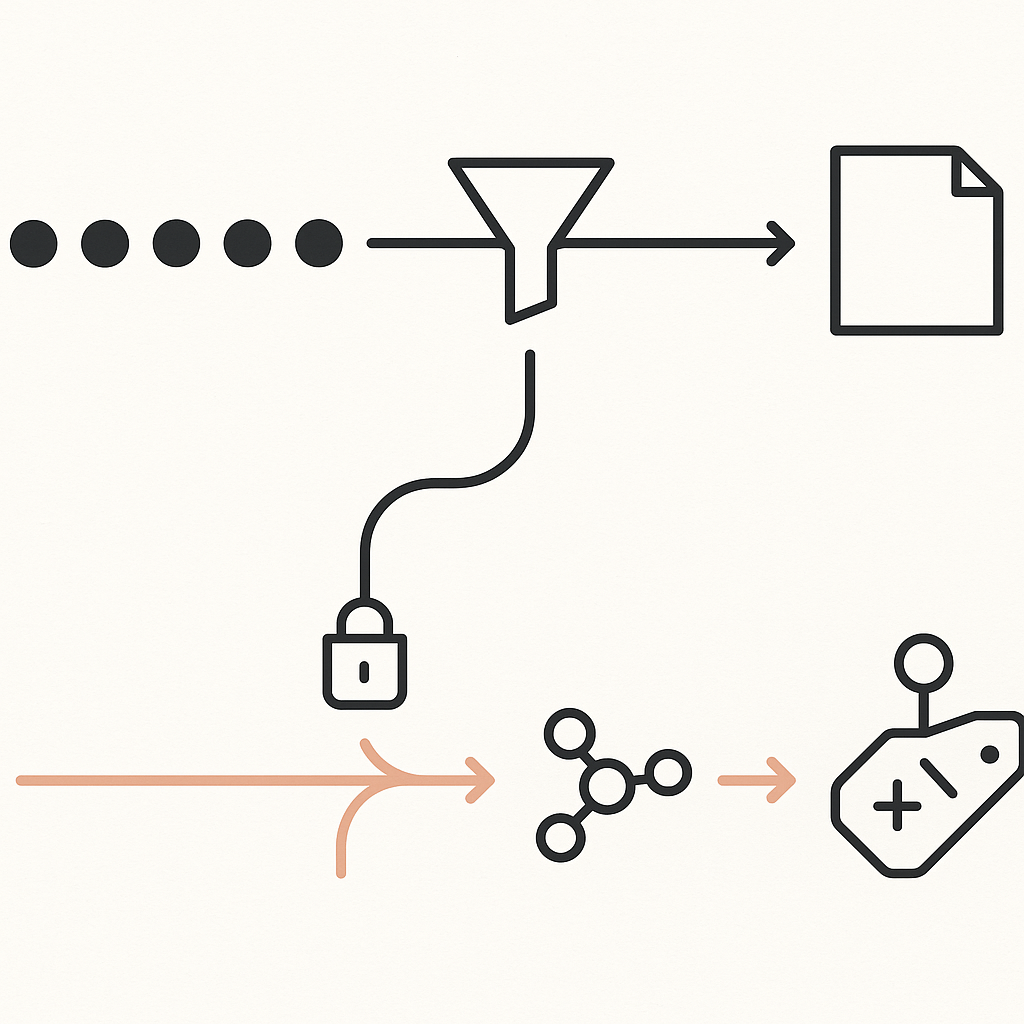
Keep measurement pipelines stable; gate optional sharing and enrichment as separate branches.
Many compliance surprises originate from treating measurement, targeting, and enrichment as one blended workflow. To reduce risk and protect reporting integrity, separate what is required for delivery verification and performance reporting from what is optional enrichment or audience expansion.
Start by documenting what is truly required to run and measure a campaign:
- Required for delivery verification: signals needed to confirm ads served and basic delivery outcomes.
- Required for performance reporting: signals needed to compute performance metrics and troubleshoot data quality.
- Optional enrichment: any additional attributes, appended segments, or expanded matching that is not necessary to produce the agreed reporting.
Then create a workflow diagram specifically for measurement data. Keep it separate from your audience sharing diagram. At minimum, it should document:
- Inputs: what events or logs feed reporting.
- Transformations: processing steps such as filtering, aggregation, matching, or deduplication.
- Outputs: reports, dashboards, exports, and who receives them.
- Recipients: internal teams and external partners who access outputs.
Finally, validate that privacy and consent controls are reflected in reporting pipelines. If consent or opt-out handling differs between test and control groups, or changes mid-flight, results can become difficult to interpret. A simple measurement governance step is to maintain a versioned record of tagging, partner configurations, and consent handling assumptions for each campaign or experiment.
Practical pre-launch QA: keep creative and performance testing from being invalidated mid-flight
.png)
Pre-launch QA is the cheapest time to catch data-flow and measurement problems. Add a checkpoint before each campaign or experiment that reviews both privacy operations and measurement stability, using the data-flow maps and partner diligence responses as inputs.
A practical pre-launch QA checkpoint can include:
- Confirm the complete data path for the campaign: collection, processing, any sharing, any enrichment, and retention expectations.
- Confirm the data path for measurement specifically, including who receives reports and whether any exports occur.
- Confirm opt-outs and retention settings align with your documented workflow and the partner’s documented practices.
For testing setups, explicitly confirm that test and control groups follow the same measurement path. Differences in tagging, IDs used, or partner processing can invalidate comparisons, even if media delivery looks normal.
Define a change-management trigger so teams know when results need re-baselining. Examples of triggers to treat as requiring review include changes to tagging, pixels, IDs, data recipients, partner configurations, or reporting exports. Operationally, this can be as simple as requiring a new QA sign-off when these elements change.
Sources
Frequently asked questions
What is New Jersey’s data broker law and why does it matter for advertising?
It matters for advertising because data practices that look like data-broker-like behavior, including through downstream partner relationships, can create compliance surprises. For publishers and marketers, those surprises can disrupt targeting, reporting, and partner operations if data flows and responsibilities are unclear. A practical response is to improve end-to-end data-flow visibility and partner governance so the organization can identify where data leaves its control and how it is used.
How can a publisher or marketer map data flows for privacy compliance in advertising?
Create a simple end-to-end map across five stages: collect, process, share/sell, enrich, and retain/delete. Include common ad and measurement components such as pixels, IDs, clean rooms, data onboarding, and analytics. Assign an owner and a system of record for each step, and clearly mark the points where data leaves your control to a partner.
What questions should advertisers ask data vendors and measurement providers about data sharing and retention?
Ask what data is collected and from where (including pixels, SDKs, and IDs), who receives the data and for what purpose, and what onward sharing occurs. Then ask how opt-outs are honored operationally, what retention and deletion practices apply, and what proof the partner can provide (documentation, logs, policies). Standardizing these questions across partners helps you spot gaps early.
How do you separate performance measurement reporting from data sharing to reduce compliance risk?
Document what is required for delivery verification and performance reporting, and treat optional enrichment as a separate workflow with separate controls. Build a measurement-specific workflow diagram that lists inputs, transformations, outputs, and recipients. Then confirm privacy and consent controls are reflected in the reporting pipeline so reporting baselines remain stable across campaigns and experiments.
.webp)
.webp)

.webp)
.webp)
.webp)