Creative Analytics in 2026: A Guide to Understanding What Makes Ads Work

Creative analysis is the process of measuring how the elements of an ad, including imagery, color, copy, format, and offer, influence attention, emotion, and action. In 2026, it is increasingly supported by AI, which can evaluate creative at scale, estimate performance before a campaign launches, and identify patterns across large libraries of ads. This guide covers what creative analysis measures, how modern tools work, which metrics matter, and how teams put it into practice.
Key Takeaways
- Creative analysis connects individual ad elements, such as the hook, headline, imagery, and call to action, to measurable outcomes.
- In 2026, AI-powered tools evaluate creative using computer vision, language models, and predictive scoring, often before launch.
- The core areas to measure are visual performance, emotional resonance, message clarity, and conversion metrics.
- Analysis and testing work as a pair. Analysis builds hypotheses, and A/B or multivariate testing confirms them.
- Tagging creative consistently by element is what makes insights reusable across campaigns.
- AI handles scale and pattern recognition, while people bring strategy, taste, and storytelling.
Exploring Creative Analytics in 2026
Advertising has always blended art and evidence. What's different today is how much evidence is available. Creative can now be broken into its parts, measured element by element, and compared across thousands of ads in a fraction of the time it once took.
Imagine walking into a creative review where every design choice, color, and headline is connected to what is known about how audiences respond. That is the practical value of creative analysis, and it is now a standard part of how modern advertising teams work.
If you're new to the topic, our foundational guide covers the basics. This 2026 edition focuses on how creative analysis works today.
What is Creative Analytics?
Creative analytics is the process of examining and measuring how the creative elements of an advertisement perform. Those elements can include anything from imagery, color schemes, headlines, body copy, calls to action, layout, video pacing, music, and tone.
It works like a microscope for your marketing creativity. It lets you break an ad into its parts, see what each part contributes, and carry those findings into future work.
What is AI Creative Analytics?
AI creative analysis uses machine learning to evaluate ad creative automatically. Several techniques work together:
- Computer vision identifies visual elements such as faces, objects, text, colors, logos, and composition, and in video, scene changes and pacing.
- Language models assess copy, tone, sentiment, and how clearly a message comes across.
- Predictive models estimate how an ad is likely to perform with a given audience, based on patterns learned from past creative and results.
- Synthetic audiences can simulate how defined audience groups might respond to creative before it runs. Learn more about how AdSkate implements synthetic audiences.
The Key Components of Creative Analysis
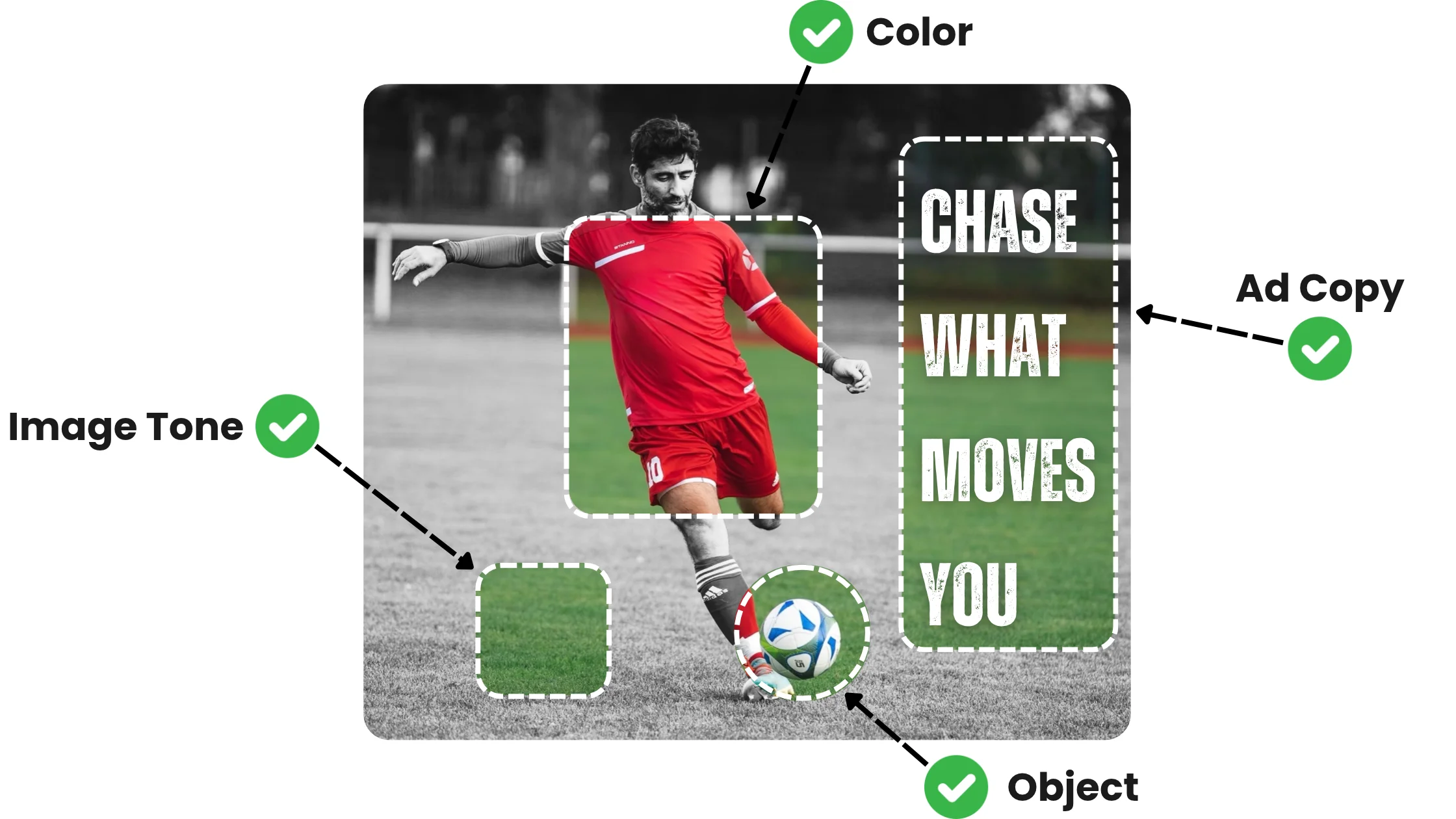
Creative analysis typically focuses on multiple areas:
- Visual performance. This covers color, imagery, composition, text legibility, logo placement, and other design choices that influence whether an ad is noticed and engaged with. For video, it includes the opening seconds, pacing, and framing.
- Emotional resonance. This looks at how audiences respond emotionally, which shapes brand connection and recall.
- Message clarity. This asks whether a viewer can quickly understand who the ad is from, what it offers, and what to do next.
- Conversion metrics. This tracks how creative elements relate to actions such as clicks, sign-ups, and purchases, connecting creative decisions to business results.
Together, these give a unified view of creative performance instead of a set of disconnected numbers.
Element-Level Analysis: The Foundation of Modern Creative Insights
The most useful shift in creative analysis is the move from judging whole ads to examining their elements.
Knowing that one ad outperformed another is helpful once. Knowing which elements drove the difference, such as the type of opening hook, the presence of people, the headline structure, or the offer, is helpful repeatedly, because those findings apply to future ads.
Element-level analysis can work by tagging each asset with its components. Common tags include:
- Format (static, carousel, short video, long video)
- Hook or opening approach
- Message theme
- Visual style and color palette
- Presence of people, product, or text overlays
- Offer type
- Call to action
Creative A/B and Multivariate Testing

Testing remains a core companion to analysis.
Creative A/B testing compares two versions of an ad that differ in a single element, such as the headline or the hero image. Multivariate testing changes several elements at once to learn which combinations work best, and it needs more volume to produce clear results.
Testing helps teams:
- Confirm which design elements resonate with an audience
- Direct ad spend toward high-performing assets
- Replace assumptions with evidence
Testing tells you which version won, and creative analysis helps explain why. Used together, they turn individual results into patterns a team can reuse.
Pre-Campaign and In-Campaign Analysis
Creative analysis can happen at different points in a campaign's life.
Pre-campaign analysis evaluates creative before launch. AI-based scoring can narrow a large set of options to a shortlist. These are predictions rather than guarantees, so they are best paired with live testing.
In-campaign analysis measures real results as they come in, identifies which elements are driving them, and flags creative fatigue as audiences see the same ad repeatedly.
Post-campaign analysis looks across the full run, and across multiple campaigns, to document what was learned and feed it into the next creative brief.
Mature teams use all three, with each stage informing the next.
Creative Analysis for Video and Short-Form Content
Video now makes up a large share of creative, and it is analyzed in its own way. Common focus areas include:
- The opening seconds, and how quickly the ad earns attention
- Pacing and scene changes
- Whether the brand and message appear early enough to register
- Use of captions and on-screen text, since many viewers watch without sound
- How well the creative fits the format of each placement
Frame-by-frame and moment-by-moment analysis lets teams see where attention rises and drops, then apply that to future edits.
Creative Analysis in the Age of Generative AI

Generative AI tools can now produce many variations of images, copy, and video quickly. That makes producing options easier, and it makes understanding them more important.
Creative analysis gives structure to this volume. It helps teams decide which variations to test, understand what the strongest performers have in common, and keep generated assets consistent with brand guidelines. The more creative a team can make, the more useful it is to have a clear method for learning from it.
The Human Touch: Creativity Meets Data
Creative analysis isn't about replacing human creativity. It supports it. Think of data as the GPS and creativity as the driver. You're still in control, but you have a clearer map.
AI is strong at processing large volumes of creative and spotting patterns. People are strong at strategy, brand judgment, cultural awareness, and emotional storytelling. Each does its best work when used for what it's suited to.
Practical Tips for Implementing Creative Analysis
- Start small. Begin with a few core metrics, such as click-through rate, engagement rate, and conversion rate.
- Document learnings. Write findings into your next creative brief so insights carry forward.
- Recheck over time. Audience behavior and creative fatigue change, so revisit past findings regularly.
- Blend intuition with insight. Data informs creative decisions, and it works alongside your creative instincts.
Creative Analysis Checklist
Before launching your next campaign, ask yourself:
- Have I tested multiple creative variations?
- Am I tracking metrics for attention, conversion, and creative impact?
- Can I explain the "why" behind my creative choices?
- Have I recorded what I learned from the last campaign?
Looking Ahead
Creative analysis continues to move closer to the creative process itself, with analysis increasingly available while assets are being built. Measurement for video and short-form content continues to mature, and the connection between creative, measurement, and production keeps getting stronger.
Conclusion
Creative analysis gives advertisers a clearer view of how their creative works. By measuring elements, testing ideas, and recording what they learn, teams build a growing body of knowledge about their audience, and every campaign adds to it.
Ready to see it in action? Book a demo to see how AI-powered insights can support your creative strategy.
FAQ
Q1. What is creative analysis?
A1. Creative analysis is the process of breaking an ad into its visual and textual elements and measuring how each affects performance. It shows why an ad connects with an audience.
Q2. What is AI creative analysis?
A2. AI creative analysis uses machine learning, including computer vision and language models, to evaluate ad creative automatically and estimate or explain its performance. It allows teams to analyze creative at a scale that manual review can't match.
Q3. What does creative analysis measure?
A3. It typically covers visual performance, emotional resonance, message clarity, and conversion metrics, and connects each to specific creative elements.
Q4.What is element-level creative analysis?
A4. Element-level analysis tags each part of an ad, such as the hook, format, message, and call to action, and looks for patterns across many ads, so learnings apply to future creative.
Q5. How is creative analysis different from A/B testing?
A5. A/B testing compares versions to find a winner. Creative analysis examines the elements inside those versions to explain the result and find patterns across tests.
Q6. What is pre-campaign creative analysis?
A6. Pre-campaign analysis evaluates creative before launch, using AI-based scoring or synthetic audiences to estimate performance. It helps narrow options, and live testing confirms the results.
Q7. Can AI replace human creativity?
A7. No. AI is effective at pattern recognition and scale. People provide strategy, brand understanding, and storytelling.