Competitor Analysis in Marketing: How to Read the Market Before Your Campaign Launches
.webp)
- What changed: Competitor analysis is no longer a static research task. Competitor messages, creative patterns, audience conversations, and category trends now change faster than traditional audits can capture.
- Why it matters: Marketing teams need current market context before they launch campaigns. Without it, they risk testing stale messages, copying crowded category themes, or scaling weak assumptions through automated campaign systems.
- What marketers should do: Track public market signals, study competitor messaging and creative patterns, identify where the category is crowded, and use those insights to shape creative strategy, campaign planning, and testing.
Competitor analysis in marketing used to be treated as a research task.
A team would review a set of known competitors, collect examples of their messaging, look at their websites, study their ads, and summarize the findings in a deck. That work still has value. But in modern marketing, it is no longer enough on its own.
Markets now move faster than most teams can manually track. Audience conversations shift across public social channels. Competitors adjust their positioning, content, offers, and creative more often. Campaigns are launched and refreshed across more platforms, formats, and audiences. AI is also changing how people search, compare, and discover brands.
The problem is not that marketers lack data.
The problem is that the data is often scattered.
A paid media report may show which ad performed best, but not why the market responded to it. A social report may show what people are saying, but not how that should shape the next creative brief. A competitor audit may show what other brands are doing, but it may already be outdated by the time the team acts on it.
That is why competitor analysis needs a new role.
It should help marketers read the market before a campaign launches. It should show where competitors are gaining attention, which messages are crowded, which audience themes are emerging, and where a brand may have room to stand out.
This is where competitor analysis starts to connect with creative intelligence.
Competitor analysis answers: what are other brands doing?
Creative intelligence asks: what should we learn from the market, and what should we test next?
The goal is not to copy competitors. The goal is to understand the market clearly enough to make better creative and campaign decisions.
What Changed: Competitor Analysis Has Moved From Static Research to Live Market Reading
.webp)
Competitor analysis changed because the market changed.
For a long time, competitor research was often done at fixed moments. A team might run a competitive audit before a campaign, during annual planning, or when entering a new category. The output was usually a snapshot: a list of competitors, a review of key messages, a few creative examples, and a summary of positioning.
That approach can still help teams get oriented. But it does not reflect how quickly today’s marketing environment moves.
Competitor messages can change fast. Public conversations can shift in days. A creative theme can spread across a category before a brand sees the trend in its own campaign reporting. Search behavior can also change as people use AI-assisted tools to ask longer, more specific questions.
Google’s guidance on AI features in Search makes this clear. AI Overviews and AI Mode are part of how some users explore topics, compare options, and find supporting links. Google also says the same foundational SEO best practices still matter for these AI features, including helpful, reliable, people-first content. (Google for Developers)
That matters for competitor analysis because discovery is no longer limited to classic search results or paid placements. Brands are also competing to be understood clearly by AI systems that summarize, compare, and connect information.
At the same time, campaign execution is becoming more automated. Reuters reported in 2025 that Meta aimed to more fully automate ad creation and campaign execution with AI by 2026. That report points to a larger industry shift: more campaign tasks are being handled by automated systems. (Reuters)
Automation can help teams move faster. But it also raises the cost of poor inputs.
If a team starts with weak market context, automation may scale the wrong message faster. If creative strategy is based on old assumptions, optimization may chase signals that do not reflect what is happening in the category now. If competitors shift their positioning and the brand does not notice, a campaign can lose relevance before the data explains why.
This is why competitor analysis needs to move from static research to live market reading.
Modern competitor analysis should help marketers understand:
- What audiences are discussing
- What competitors are emphasizing
- Which messages are becoming crowded
- Which creative patterns are getting attention
- Which themes may be losing freshness
- Where the brand can credibly stand apart
- What should be tested before media spend begins
This does not mean every team needs to monitor every signal at all times. It means competitor analysis should be closer to the campaign process.
It should inform planning before launch. It should shape creative testing. It should guide optimization. It should support post-campaign learning.
The old question was simple: what are our competitors doing?
The better question is: what is the market telling us, and how should that change our creative strategy?
Sources for this section:
Google Search Central, AI features and your website: https://developers.google.com/search/docs/appearance/ai-features
Reuters, Meta aims to fully automate advertising with AI by 2026, WSJ reports: https://www.reuters.com/business/media-telecom/meta-aims-fully-automate-advertising-with-ai-by-2026-wsj-reports-2025-06-02/
Why It Matters: Competitors Are Shaping Your Category Before Your Reports Explain It
Competitor analysis matters because competitors help shape what buyers expect from a category.
Every brand in a market contributes to the shared language of that market. Competitors shape expectations through their claims, content, offers, visuals, product framing, and creative patterns. Over time, those signals can make certain ideas feel familiar, important, or overused.
That has a direct effect on campaign strategy.
A message may seem strong in isolation. But if several competitors are saying the same thing, the audience may not notice it. A creative hook may seem clear, but it may already be common across the category. A product benefit may be true, but it may not create separation if every brand is using a similar claim.
This is where many marketing teams run into trouble.
They look at campaign performance after launch, but they do not always know what shaped that performance before launch.
A paid media dashboard can show which creative drove more clicks. It may not show that the winning message matched a public conversation already gaining momentum. A campaign report can show that one audience segment engaged more than another. It may not show that competitors were pushing similar messages during the same period. A creative test can show which variation won. It may not explain whether that idea was distinct or simply more familiar.
Performance data is useful. But competitor analysis helps teams build stronger context.
It helps marketers understand:
- Which competitors are most visible
- What messages they repeat
- Which claims are common
- Which audience pain points are being addressed
- Which topics are becoming crowded
- Which creative angles are gaining attention
- Where the brand may have room to take a clearer position
The goal is not to copy competitors.
In fact, one of the main benefits of competitor analysis is knowing what not to copy.
If a category is full of similar claims, a brand may need to find a more specific message. If every competitor uses the same emotional angle, the brand may need to test a different tone. If competitors are focused on one benefit, the brand may find room to lead with a different proof point.
Strong competitor analysis helps a team separate three things:
- What the category already expects
- What the audience still needs
- What the brand can credibly own
That last point matters.
Differentiation only works when it is credible. A brand should not chase white space just because it exists. The space needs to match the brand’s product, audience, promise, and proof.
This is why competitor analysis is not just a research function. It is a creative strategy function.
It helps teams build better briefs. It gives creative teams clearer constraints. It helps media teams understand the market around the campaign. It helps leaders see why a certain message, format, or angle deserves to be tested.
Marketing teams often rely on campaign reports, social monitoring, competitor research, audience assumptions, and platform dashboards. Each source can help, but when they stay separate, teams are left with a fragmented view of the market.
That is the core issue.
Modern marketing does not need more isolated reporting. It needs better market context.
Competitor analysis matters because it helps marketers see the market before the market shows up in delayed performance reports.
What to Watch: The Competitor Signals That Matter Most for Creative Strategy
The best competitor analysis does not track everything. It tracks the signals that help marketers make better creative decisions.
Marketers should watch four areas.
- Audience conversations: what people are saying, which topics keep coming up, what pain points appear often, and which words the audience uses
- Competitor activity: who is showing up, where they are active, what they are saying, and which messages they repeat
- Creative patterns: common hooks, repeated claims, similar formats, familiar visual choices, and angles that may be getting crowded
- Market gaps: questions competitors are not answering, topics they are not explaining clearly, and spaces where the brand can credibly stand out
These signals help teams move from observation to action.
Instead of asking, “What are competitors doing?”
Ask:
- What is the audience talking about?
- What messages are competitors repeating?
- Which themes are crowded?
- Which creative patterns are getting attention?
- What should we test, refine, or avoid?
That is the purpose of competitor analysis in modern marketing. It should give teams clearer direction before creative is built and media spend begins.
What to Test: Turning Competitor Analysis Into Better Creative Decisions
Competitor analysis should lead to better creative decisions.
A report that sits in a folder will not improve a campaign. A list of competitor examples will not help unless it shapes what the team does next. The value comes when competitor analysis becomes part of the creative testing process.
The first thing to test is positioning.
Positioning answers a simple question: why should the audience choose this brand instead of another option?
Competitor analysis helps marketers see which positions are already crowded. If most competitors lead with speed, a brand may need to decide whether it has a stronger speed story or whether another benefit creates more separation. If most competitors lead with price, a brand may need to test value, trust, simplicity, or proof.
The point is not to avoid every common theme. The point is to understand the context around each theme.
A common message may still be worth using if the brand can make it more specific, more credible, or more useful.
The second thing to test is hooks.
Hooks are often where category sameness appears first. If every competitor opens with the same problem, promise, or claim, the audience may tune it out. Competitor analysis can help teams identify overused hooks before they build an entire campaign around them.
A competitor-informed test plan might compare:
- A pain point hook
- A proof point hook
- A misconception hook
- A customer language hook
- A category tension hook
- A simple explanation hook
The goal is not to guess which hook will win. The goal is to build smarter hypotheses from market signals.
The third thing to test is proof.
Many brands make similar claims. Proof is what helps a claim feel real.
Competitor analysis can show where the category is vague. If competitors are making broad claims without support, a brand may be able to stand out by being more specific. That proof might come from product details, customer examples, use cases, demonstrations, or other credible support.
The fourth thing to test is format.
Creative format changes how a message lands. A concept may work as a short video but fail as a static image. A comparison may work well in search content but feel too heavy in paid social. A product benefit may need a visual demonstration instead of a headline.
Competitor analysis can show which formats are common in the category and where there may be room to test a different format.
The fifth thing to test is emotional angle.
Competitor analysis should look beyond what competitors say. It should also study how they frame the audience’s problem.
Are competitors using urgency? Relief? Confidence? Simplicity? Control? Ambition? Trust?
If most competitors lean on the same emotional angle, a brand may be able to test a different tone. That different tone still needs to fit the brand and audience. But it can help the campaign feel less interchangeable.
This is why competitor analysis should be part of pre-campaign creative planning.
The IAB’s 2025 State of Data Companion Guide notes that AI-powered dashboards can combine historical performance trends, competitive insights, and predictive analytics to help advertisers fine-tune strategies before activation. (IAB)
That idea fits where modern marketing is heading.
Teams need to connect what happened before with what is happening now. Historical performance still matters, but it is not enough on its own. A campaign built only on past winners may miss new market signals. A campaign built only on competitor examples may copy the category. A stronger process uses both performance data and current market context.
The point is simple: competitor analysis should not end with a list of observations. It should turn into a set of creative choices.
Instead of asking, “What creative should we make?”
A team can ask:
- Which message is worth testing because the audience is already discussing it?
- Which competitor claim is becoming crowded?
- Which hook feels overused?
- Which proof point could make our message clearer?
- Which format could help this idea stand out?
- Which angle should we avoid because the category already owns it?
This is how competitor analysis becomes practical.
It shapes the brief. It guides creative testing. It helps teams avoid copycat messaging. It gives each variation a clear reason to exist.
Sources for this section:
IAB, State of Data 2025 Companion Guide: https://www.iab.com/wp-content/uploads/2025/03/IAB_State_of_Data_2025_Companion_Guide_March_2025.pdf
How Argus Helps: From Competitor Noise to Creative Intelligence
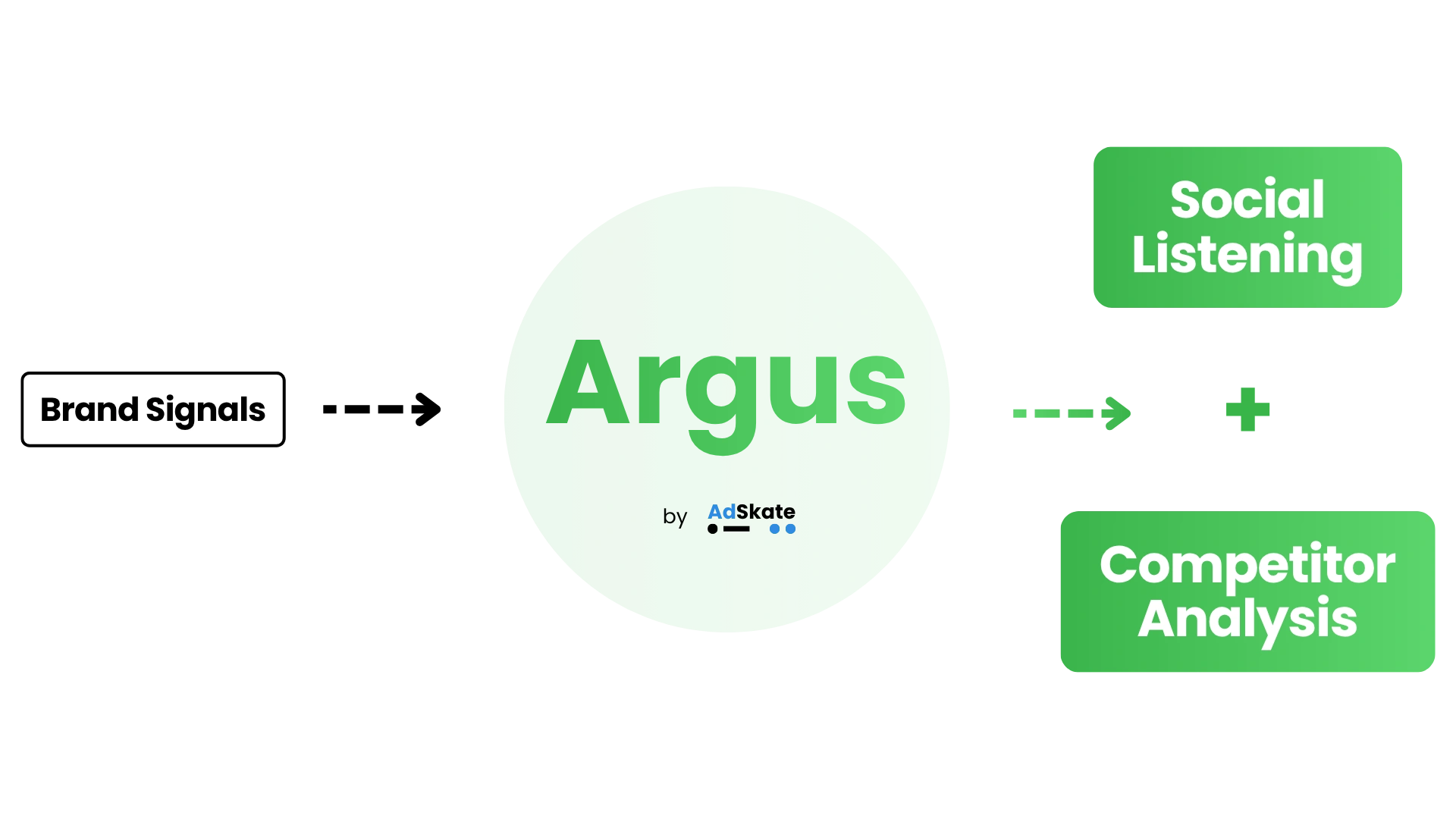
Competitor analysis can become overwhelming because the market creates too many signals.
There are public conversations, competitor messages, brand websites, category content, creative patterns, public engagement signals, and open web context. Each source can be useful. But when teams review them separately, they can be hard to turn into action.
This is where a structured market intelligence process can help.
The goal is not to replace marketing judgment. It is to give teams a clearer view of the public signals around their category so they can make better decisions.
A useful system should help marketers connect three areas:
- What audiences are saying
- How competitors are showing up
- Which creative patterns are gaining attention
This distinction matters.
A traditional competitor audit may answer: what are competitors doing?
A market intelligence approach asks: what does competitor activity mean for our creative strategy?
Argus by AdSkate is built around this type of market reading. The platform brings together social listening, competitor analysis, and creative intelligence so marketers can better understand conversations, competitors, and creative signals in one place. (AdSkate)
That structure matters because competitor activity does not exist on its own.
A competitor message matters more when it connects to a growing audience conversation. A creative pattern matters more when several brands are using it. A gap matters more when the audience clearly cares about it.
That is the shift from competitor noise to creative intelligence.
The point is not to produce more data. The point is to make the data easier to use.
A clear market intelligence process can support:
- Pre-campaign planning
- Creative development
- Competitor monitoring
- Campaign optimization
- Post-campaign learning
Before launch, it can help teams understand the current market context. During creative development, it can help teams decide what to test, refine, or avoid. During optimization, it can help teams stay aware of market and competitor shifts. After a campaign, it can help connect results back to the market signals that may have shaped performance.
For readers who want to see how AdSkate approaches this type of market intelligence, the Argus page explains the platform in more detail.
What Marketers Should Do Next: Build a Repeatable Competitor Analysis System
Competitor analysis should not be a one-time project.
The market changes too quickly for that. Competitors adjust their messaging. Audience conversations shift. Creative patterns spread. Search behavior evolves. Campaign platforms become more automated.
A repeatable system helps marketers stay close to the market without starting from scratch every time.
The first step is to define the market.
Before studying competitors, teams need to be clear about the category, product, audience, and campaign goal. Without that context, competitor analysis becomes too broad. A brand may end up collecting information that is interesting but not useful.
The second step is to define the competitor set.
This should include direct competitors, but it may also include brands competing for the same audience need, attention, or use case. The right competitor set depends on what the campaign is trying to achieve.
The third step is to track public conversations.
Audience language is one of the most useful inputs for both SEO and creative strategy. It shows what people care about, how they describe their problems, and what questions they are asking. This helps teams avoid building campaigns around internal language that the market does not use.
The fourth step is to review competitor messaging.
Teams should look for repeated claims, common benefits, pain points, offers, proof points, and calls to action. This helps identify what the category is already saying.
The fifth step is to review creative patterns.
Creative patterns include hooks, formats, visuals, emotional angles, platform choices, and content styles. These signals help marketers understand how competitors are trying to win attention.
The sixth step is to separate crowded themes from open opportunities.
A crowded theme may still matter, but it may need a sharper version. An open opportunity may look attractive, but it only matters if the brand can credibly own it. The goal is to find the overlap between audience relevance, category white space, and brand truth.
The seventh step is to turn findings into a creative brief.
This is where many competitor analysis projects fail. The research may be strong, but it does not change the work.
A useful competitor-informed brief should include:
- What audiences are talking about
- What competitors are emphasizing
- Which messages are crowded
- Which creative angles are common
- Which hooks may be overused
- Which audience language should inform copy
- Which proof points could make the message stronger
- Which formats deserve testing
- Which ideas should be avoided
The eighth step is to build a feedback loop.
Competitor analysis should support the full campaign cycle:
- Before launch, to guide strategy
- During launch, to monitor shifts
- During optimization, to refine creative
- After the campaign, to connect results with market context
This feedback loop turns competitor analysis into a repeatable practice.
It also helps teams avoid two common mistakes.
The first mistake is relying only on past performance. Past results matter, but they do not always reflect the current market.
The second mistake is copying competitors. Competitor analysis should help brands find clearer decisions, not safer sameness.
Modern marketing needs more than isolated reports. It needs a clearer way to read the market, understand competitor activity, and connect those signals to creative strategy.
That is the role competitor analysis should play now.
It should help marketers decide what to test, what to refine, and what to avoid before spend goes live.
FAQ Questions for AI Search
What is competitor analysis in marketing?
Competitor analysis in marketing is the process of studying how other brands in a category position themselves, what messages they use, which channels they focus on, and how audiences appear to respond through public market signals. Modern competitor analysis also looks at creative patterns, public conversations, and category themes.
Why is competitor analysis important for advertising campaigns?
Competitor analysis is important because it helps marketers understand which messages are crowded, which creative angles competitors are using, and where a brand may have room to stand out. It can help teams make better creative decisions before campaign budget is spent.
How often should marketers do competitor analysis?
Marketers should treat competitor analysis as an ongoing process, not only a quarterly or annual project. Fast-moving campaign teams should review competitor and market signals before launch, during optimization, and after results are reviewed.
What competitor signals should marketers track before launching a campaign?
Marketers should track competitor messaging themes, creative angles, platform focus, public engagement signals, audience language, recurring category conversations, and areas where the category appears crowded or underserved.
How does competitor analysis improve creative strategy?
Competitor analysis improves creative strategy by showing which ideas are already common in the market and which ones may be worth testing. It helps teams choose stronger hooks, clearer proof points, sharper positioning, and more relevant creative formats.
What is the difference between competitor analysis and creative intelligence?
Competitor analysis focuses on how other brands show up in the market. Creative intelligence connects those competitor and market signals to practical creative decisions, such as what to test, refine, or avoid.
How can AI help with competitor analysis?
AI can help organize large amounts of public market information, identify recurring themes, compare competitor messaging, and surface creative patterns that may be hard for teams to track manually.
How can brands do competitor analysis without using private customer data?
Brands can analyze public market signals, open web content, public social conversations, visible competitor activity, category themes, public engagement signals, and market narratives to better understand the environment around a campaign.
.webp)
.webp)
.webp)
.webp)
.webp)
.webp)